

Hair Transplant Options
The media has perpetuated many rumours and myths about hair transplants. Many people worry that their hair transplants will look fake. However, hair transplants can be very effective and can also look extremely natural when done by an experienced doctor.

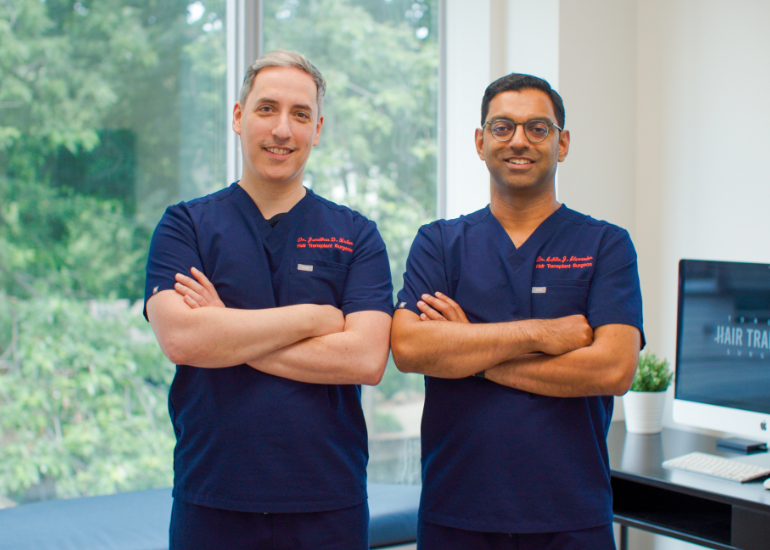
Toronto Hair Transplant Surgeons are internationally known for our pioneering work in hair transplantation.
If you are considering a hair transplant in Toronto, one of the first questions is:
Which Hair Transplant Option is Right for Me?
There is no single answer.
Hair transplant options vary depending on:
- Your stage of hair loss
- Your goals
- Donor hair availability
- Long-term planning
At Toronto Hair Transplant Surgeons, we approach hair restoration with a focus on clarity and precision.
Your procedure is surgeon-led and surgeon-controlled, from surgical planning and hairline design to graft harvesting and site creation. Your surgeon personally performs the critical surgical steps, while a highly trained technical team assists with graft handling and placement under the surgeon’s direct supervision. This approach ensures precision, safety, and natural results.
The goal is not simply to choose a procedure — it is to choose the right strategy for your hair loss.
Understanding Hair Transplant Options in Toronto
Hair transplant options are not just about technique.
They involve:
- When to proceed with surgery
- Which method to use
- How to plan for future hair loss
- Whether non-surgical treatment should be included
Many patients researching hair transplant options in Toronto are comparing:
- FUE vs FUT
- Surgical vs non-surgical treatment
- Timing of surgery
The most important step is understanding your current stage of hair loss.
A treatment that is appropriate today may not be appropriate five years from now — which is why long-term planning is essential.

Hair Transplant Basics
A hair transplant is a procedure that moves healthy hair follicles from the donor area to areas of thinning or loss.
These follicles:
- Are resistant to hair loss
- Continue to grow permanently
- Blend naturally with existing hair
The two primary techniques are:
FUE (Follicular Unit Extraction)
- Individual follicle removal
- Minimal visible scarring
- Greater styling flexibility
FUT (Follicular Unit Transplantation)
- Strip harvesting method
- Higher graft yield
- Fine linear scar
Both techniques can produce excellent results when performed properly.
The difference is not just the method — it is how the method is applied.
Why Choose FUE?
FUE (Follicular Unit Extraction) is a highly precise hair transplant technique that allows for individual follicle harvesting and targeted placement.
It is often selected when flexibility, detail, and minimal visible scarring are priorities.
Advantages of FUE
No Linear Scar
FUE does not require removal of a strip of tissue, allowing patients to wear shorter hairstyles without a visible linear scar.
Greater Styling Flexibility
Because follicles are extracted individually across the donor area, there is more freedom in how the hair can be worn after surgery.
Precision in Hairline and Detail Work
FUE allows for careful placement of individual grafts, making it particularly effective for hairline restoration and areas requiring refined density.
Selective Graft Harvesting
Individual extraction allows the surgeon to choose grafts based on quality, thickness, and suitability for specific areas.
Considerations with FUE
FUE is more time-intensive and technically demanding.
- Procedure times are typically longer
- Large graft sessions may require more planning
- Donor area management must be carefully controlled
For patients requiring a high number of grafts, FUT may offer greater efficiency.
When FUE May Be the Right Choice
FUE is often recommended for patients who:
- Are in the early to moderate stages of hair loss
- Require detailed hairline work
- Prefer shorter hairstyles
- Want to avoid a linear scar
- Benefit from a more targeted, flexible approach
At Toronto Hair Transplant Surgeons, FUE is selected when it aligns with your long-term plan — not simply because it is popular.
Your procedure is surgeon-led and surgeon-controlled, ensuring precise graft selection, placement, and natural results.
Why Choose FUT?
FUT (Follicular Unit Transplantation) is a highly efficient hair transplant technique designed to maximize graft yield and donor utilization.
It is often selected when larger areas require coverage and long-term donor preservation is a priority.
Our Results
Toronto Hair Transplant Surgeons are internationally known for our pioneering hair transplantation work.
Our huge archive is here to help you see what we can do for you. Use the link below to view some sample cases.
Advantages of FUT
Higher Graft Yield in a Single Session
FUT allows for a greater number of grafts to be harvested in one procedure, making it well suited for advanced hair loss.
Efficient Use of Donor Hair
By harvesting from a concentrated donor strip, FUT preserves surrounding areas for potential future procedures.
Consistent Graft Quality
Grafts are prepared under magnification, allowing for strong, uniform follicular units.
Lower Cost per Graft
FUT is typically more cost-efficient, particularly for patients requiring larger graft counts.
Considerations with FUT
FUT involves a fine linear scar in the donor area.
- This is usually not visible with longer hairstyles
- Recovery may differ slightly compared to FUE
These factors are important when considering overall treatment goals and lifestyle preferences.
When FUT May Be the Right Choice
FUT is often recommended for patients who:
- Require a large number of grafts
- Have more advanced hair loss
- Want to maximize donor efficiency
- Prefer a cost-effective approach for larger sessions
- Do not plan to wear very short hairstyles
At Toronto Hair Transplant Surgeons, FUT is selected when it provides a strategic advantage in achieving natural, long-term results.
Your procedure is surgeon-led and surgeon-controlled, ensuring that donor harvesting, graft preparation, and placement are performed with precision.
THTS Gallery

Familiarize yourself with our layout before you come in.
Visit the gallery to take a peek at our Oakville based clinic layout and surgical rooms.
FUE vs FUT: Which Hair Transplant Option Is Right for You?
One of the most common questions patients ask is:
“Which is better — FUE or FUT?”
The answer is not based on preference or trend. It is based on your hair loss pattern, donor supply, and long-term plan.
Both FUE (Follicular Unit Extraction) and FUT (Follicular Unit Transplantation) are proven, effective techniques. When performed properly, both can produce natural, long-lasting results.
The difference lies in how the grafts are harvested — and how that impacts your overall treatment strategy.
FUE (Follicular Unit Extraction)
FUE involves extracting individual hair follicles directly from the donor area.
This approach offers:
- No linear scar
- Greater flexibility with shorter hairstyles
- Precise, selective harvesting
- Less tension on the scalp
FUE is often best suited for:
- Early to moderate hair loss
- Hairline-focused procedures
- Patients who prefer shorter hairstyles
- Cases requiring targeted graft placement
FUT (Follicular Unit Transplantation)
FUT involves removing a thin strip of donor tissue, from which grafts are carefully prepared.
This approach offers:
- Higher graft yield in a single session
- Efficient use of donor hair
- Consistent graft quality
- A strategic advantage for advanced hair loss
FUT is often best suited for:
- Patients requiring a large number of grafts
- More advanced stages of hair loss
- Long-term restoration planning
- Patients who wear longer hairstyles
The Most Important Difference
The key difference is not just the technique — it is how each technique fits into your long-term plan.
A well-executed transplant should:
- Look natural today
- Continue to look appropriate in 5–10 years
- Preserve donor hair for future needs
Why the Right Choice Matters
Choosing the wrong technique can:
- Limit future options
- Overuse donor hair
- Create unnatural density patterns
Choosing the right technique allows for:
- Better long-term outcomes
- More natural appearance
- Strategic planning over time
At Toronto Hair Transplant Surgeons, we do not favor one technique over another.
Your procedure is surgeon-led and surgeon-controlled, and the decision between FUE and FUT is based entirely on what will provide the best long-term result for you.
FUE vs FUT: Side-by-Side Comparison
Feature | FUE (Follicular Unit Extraction) | FUT (Follicular Unit Transplantation) |
Harvesting Method | Individual follicle extraction | Strip of donor tissue |
Scarring | No linear scar | Fine linear scar |
Graft Yield | Moderate per session | Higher per session |
Procedure Time | Longer | Shorter for large sessions |
Best For | Hairline, smaller areas | Advanced hair loss |
Hairstyle Flexibility | Ideal for short hair | Better for longer hair |
Donor Preservation | Distributed extraction | Concentrated extraction |
Cost per Graft | Higher | Lower |
Recovery | Slightly quicker | Slightly longer |
Long-Term Strategy | Flexible | Efficient for large restoration |
How to Use This Comparison
This table is a general guide — not a final recommendation.
The right approach depends on:
- Your specific hair loss pattern
- Your goals
- Your donor supply
- Your long-term plan
A consultation is the only way to determine which option is best for you.
How to Choose the Right Hair Transplant Option
Most patients don’t need more information — they need clarity.
The questions below reflect how we guide patients during a consultation. As you read through them, you will likely start to see which direction applies to you.
Step 1: What Stage of Hair Loss Are You In?
- Early hair loss (receding hairline, mild thinning)
→ You may benefit from FUE or even non-surgical treatment first - Moderate hair loss (hairline + some crown thinning)
→ A strategic approach (FUE or FUT) may be recommended - Advanced hair loss (significant front + crown loss)
→ FUT or combination approach may provide the best long-term result
Step 2: How Important Is Hairstyle Flexibility?
- I want to wear my hair short
→ FUE is often the better option (no linear scar) - I typically wear my hair longer
→ Both FUE and FUT may be appropriate
Step 3: How Many Grafts Are Likely Needed?
- Smaller, targeted area (hairline)
→ FUE is often ideal - Larger areas needing coverage
→ FUT may provide better efficiency and donor use
Step 4: What Is Your Long-Term Plan?
- I want a subtle improvement now
→ Conservative FUE may be appropriate - I want to address larger areas over time
→ FUT or staged procedures may be recommended - I’m not sure how my hair loss will progress
→ A conservative approach is often best
Step 5: Are You Ready for Surgery?
- I want to act now
→ Surgical options may be appropriate - I’m unsure or still early in hair loss
→ Non-surgical treatment may be the better first step
The Next Step Is Clarity
This framework is a starting point — not a final recommendation.
The right approach depends on:
- Your specific hair loss pattern
- Your donor hair
- Your long-term goals
A consultation allows us to walk you through this process in detail and create a plan tailored to you.
Real Clinical Scenarios: How We Choose the Right Hair Transplant Option
Choosing between hair transplant options is not about selecting a technique — it is about making the right decision for your specific stage of hair loss.
At Toronto Hair Transplant Surgeons, this decision is made the same way every time:
by evaluating your current pattern, your donor supply, and how your hair loss is likely to progress.
Below are the most common clinical scenarios we see — and how those decisions are made in practice.
Scenario 1: Receding Hairline (Most Common Case)
A patient presents with:
- Receding temples or early hairline changes
- Good overall density behind the hairline
- Strong donor area
Typical Recommendation: FUE
Why:
- Hairline work requires precision and artistry
- Individual graft placement is critical for natural appearance
- Graft numbers are moderate and targeted
This is one of the most common cases we see.
The goal is not to create a “new” hairline — but to restore a natural one that fits your face and will continue to look appropriate over time.
Scenario 2: Crown Thinning (High Hesitation Case)
A patient presents with:
- Thinning at the crown
- Existing hair still present
- Uncertainty about whether surgery is necessary
Typical Recommendation: Often Non-Surgical First
Why:
- Crown thinning can respond well to PRP or medical therapy
- Existing follicles should be preserved whenever possible
- Surgery may be more effective later if needed
This is where many patients benefit from patience.
Rushing into surgery too early can:
- Damage existing hair
- Use donor hair inefficiently
In these cases, we often begin with a structured treatment plan before considering transplant.
Scenario 3: Frontal + Crown Loss (Balanced Planning Case)
A patient presents with:
- Receding hairline
- Thinning crown
- Moderate overall hair loss
Typical Recommendation: Strategic Approach (FUE or FUT depending on graft needs)
Why:
- Not all areas can be treated equally in one session
- The hairline is typically prioritized
- Crown may be staged for later treatment
This is where long-term planning becomes critical.
The goal is not to do everything at once — it is to do the right things in the right order.
Scenario 4: Advanced Hair Loss (Maximum Coverage Case)
A patient presents with:
- Significant loss across the front and crown
- Limited donor supply relative to the area needing coverage
Typical Recommendation: FUT or Combination Approach (FUT + FUE)
Why:
- Higher graft yield is required
- Donor efficiency becomes critical
- Coverage must be prioritized strategically
In these cases, FUT often provides a strong foundation because it allows for:
- More grafts in a single session
- Better preservation of donor hair for future use
The focus shifts from density everywhere → to strategic, natural coverage
Scenario 5: Younger Patient (Timing & Risk Case)
A patient presents with:
- Early signs of hair loss
- Family history of progression
- Desire to “fix it now”
Typical Recommendation: Conservative Approach (Often Delay or Limited FUE)
Why:
- Hair loss is likely to continue
- Over-aggressive treatment early can create unnatural results later
- Donor hair must be preserved
This is one of the most important decisions we make.
In some cases, the right recommendation is:
Not to proceed with surgery yet
Because timing matters just as much as technique.
Scenario 6: Patient Focused on Hairstyle Flexibility
A patient presents with:
- Preference for short hairstyles
- Concern about visible scarring
Typical Recommendation: FUE
Why:
- No linear scar
- Greater flexibility with shorter hair
- Distributed donor harvesting
Lifestyle plays an important role in selecting the right approach.
What These Scenarios Have in Common
Each of these examples highlights the same principle:
There is no single “best” hair transplant option — only the best option for your situation.
At Toronto Hair Transplant Surgeons, every recommendation is based on:
- Your pattern of hair loss
- Your donor supply
- Your long-term outlook
Your procedure is surgeon-led and surgeon-controlled, ensuring that these decisions are made with precision, experience, and a focus on natural, lasting results.
Why This Matters for Your Outcome
Choosing the right approach means:
- Preserving donor hair for the future
- Avoiding unnatural density patterns
- Creating results that age well
- Reducing the likelihood of needing corrective surgery
Choosing the wrong approach can do the opposite. That is why the consultation is not just about selecting a procedure — it is about building a plan.
Not sure which scenario you fall into? Book a consultation and we’ll walk you through it.
PRP for Hair Transplant
PRP (Platelet-Rich Plasma) is often used as a complementary treatment.
Patients frequently ask whether PRP is a hair transplant option.
The answer is:
PRP is not a replacement for surgery — but it can support results.
PRP is commonly used to:
- Strengthen existing hair
- Improve scalp health
- Support healing after surgery
PRP may be recommended:
- Before a transplant to stabilize hair loss
- After a transplant to support graft survival
- As part of a long-term maintenance plan
Hair Transplant for Adult Patients
Many patients researching hair transplant for adults are unsure when to proceed.
The timing of surgery is critical.
Younger Patients
- Hair loss may still be progressing
- Conservative planning is essential
Mature Patients
- Hair loss is often more stable
- Long-term planning is clearer
Can a 60-Year-Old Get a Hair Transplant?
Yes.
Age alone does not determine candidacy.
The key factors are:
- Donor hair quality
- Overall health
- Hair loss stability
In many cases, older patients are excellent candidates because their hair loss pattern is already established.
Male Hair Transplant Options
Men typically experience:
- Receding hairline
- Crown thinning
- Progressive hair loss
Treatment options include:
- Non-surgical therapy
- Surgical hair restoration
Female Hair Transplant Options
Women often experience:
- Diffuse thinning
- Widening part
- Crown thinning
Treatment approaches differ significantly.
Hair Transplant Cost, Pricing and Consultation
Hair transplant cost in Toronto depends on:
- Number of grafts
- Procedure type
- Complexity
Typical pricing ranges:
- $6,000–$25,000+
Patients searching:
should understand that pricing reflects:
- Surgical precision
- Time required
- Expertise
Hair Transplant Options Graft Cost Comparison
Understanding graft cost helps clarify pricing differences.
Procedure | Cost per Graft | Best For |
FUT | $4–$6 | Large graft sessions |
FUE | $6–$10 | Precision + flexibility |
Total cost depends on:
- Number of grafts
- Desired density
- Hair characteristics
The goal is not to maximize graft count — but to use grafts effectively.
How Many Sessions Are Needed?
Most patients complete treatment in one session.
However, multiple sessions may be required if:
- Hair loss is advanced
- Density is built gradually
- Future loss is anticipated
Some patients choose staged treatment:
- Hairline first
- Crown later
This allows for:
- Better long-term results
- More natural progression
Recovery and Timeline
Hair transplant recovery follows a predictable pattern.
Week 1
- Healing
- Mild redness
Weeks 2–4
- Shedding
Months 3–4
- New growth begins
Months 6–12
- Final results
Hair restoration takes time — but the results are designed to last.
Advantages of Choosing the Right Hair Transplant Option
Selecting the correct approach provides:
Natural Results
Hair grows in the correct direction and density.
Long-Term Stability
Results are designed to age naturally.
Efficient Use of Donor Hair
Preserves options for the future.
Improved Confidence
Restores appearance and self-image.
Articles About Hair Transplant Options
We encourage patients to learn about:
- FUE vs FUT
- Cost considerations
- Recovery timelines
- Long-term maintenance
Explore our educational content to better understand your options.
FAQs on Hair Transplant Options
How much does a hair transplant cost in Toronto?
Most procedures range from $6,000–$25,000+.
Summary: Cost depends on graft count and complexity.
Will a hair transplant stop further hair loss?
No. It restores hair but does not stop ongoing loss.
Summary: Additional treatment may be needed.
How does a hair transplant work (FUE vs FUT)?
Hair is moved from donor to thinning areas using either individual extraction (FUE) or strip harvesting (FUT).
Summary: Both techniques are effective.
Which is more effective: FUE or FUT?
Both can produce excellent results when properly performed.
Summary: The best option depends on your case.
Your Next Step
Choosing between hair transplant options is not about selecting a technique — it is about choosing the right plan.
- Book a consultation
- Explore your options
- Get a personalized recommendation
We are here to guide you — with expertise, precision, and a long-term approach designed for natural results.